



Your Microsoft Teams Calls Are Working. But Are They Working for Your Business?
For many organisations, migrating phone calling to Microsoft Teams is a major milestone. Employees can work from anywhere, calls are routed efficiently, and legacy telephony systems become a thing of the past.
Once the migration is complete, the focus naturally shifts elsewhere. If people can make and receive calls without disruption, the project is often considered a success.
But that is only the beginning.
A modern phone system tells you that calls are happening, but it doesn't necessarily tell you whether those calls are helping your business perform better.
That matters to end users, but it matters to their service providers too. Once Teams calling is in place, customers begin to expect more than connectivity. They want to understand performance, improve service and solve the operational problems that sit behind their calls. For service providers, meeting those needs is an important part of remaining relevant to customers long after deployment.
What Happens After Go-Live?
As businesses become more reliant on Teams for customer communication, different questions begin to emerge.
How long are customers waiting before someone answers?
Are missed calls being returned?
Are workloads distributed fairly across the team?
Which departments consistently provide the best customer experience?
For many organisations, these questions are surprisingly difficult to answer. Managers often rely on assumptions or anecdotal feedback because the operational insight simply isn't available. The calls are taking place everyday, but the information needed to improve them remains hidden.
For service providers, this gap is significant because these are exactly the kinds of needs that can determine how much value a customer continues to see in its communications service. If an end user is struggling with missed calls, poor response times or inconsistent service, simply providing the underlying Teams environment is no longer enough. Helping customers understand and address those issues strengthens the service itself – and gives them more reason to stay with the provider delivering it.
This creates a visibility gap. Teams supports communication exceptionally well, but without analytics, organisations are often unable to understand what happens beneath the surface.
The Cost of What You Can't See
Every missed call represents a customer who needed something.
Every abandoned call suggests someone decided waiting wasn't worth it.
Every overloaded employee risks delivering a poorer customer experience than they otherwise could.
Individually these moments may appear insignificant. Collectively they influence customer satisfaction, employee performance and commercial outcomes.
The challenge isn't that businesses don't care about these issues, but that many don't have the data needed to identify where problems exist, how frequently they occur or whether recent changes have actually improved performance.
Without visibility, organisations are left reacting to complaints rather than preventing them.
Call analytics gives service providers another way to support customers before those issues become reasons for dissatisfaction. Rather than waiting for a customer to report a problem, providers can use analytics to understand calling patterns, identify areas that may need attention and have more informed conversations about service performance.
This makes analytics useful on both sides of the relationship. End users gain the insight they need to improve their own operations, while service providers can use the same intelligence to deliver a better service around them.
Turning Questions Into Evidence
Call analytics changes the conversation.
Instead of asking whether customers might be waiting too long, businesses can see exactly how long callers remain in a queue before abandoning the call.
Instead of assuming workloads are balanced, managers can understand how calls are distributed across individuals and teams.
Instead of discovering service issues after customers complain, trends become visible while there is still time to act – providing the evidence needed to make swift, confident decisions.
Even relatively small adjustments can produce measurable results. If abandonment consistently increases after twenty seconds, additional staff may only be required during specific periods of the day. Alternatively, introducing a simple reassurance message while callers wait may reduce abandonment without increasing headcount.
The difference is that decisions become informed by real customer behaviour rather than educated guesses.
For a service provider, this insight makes it easier to respond to what individual customers actually need. One customer may be concerned about missed opportunities. Another may need to understand why service levels differ between locations. A growing business may simply need better visibility as call volumes increase. Analytics enables the provider to address those needs with evidence rather than offering the same generic service to every customer.
That ability to solve real operational problems is important for retention. Customers are less likely to view their provider as interchangeable when the service continues to evolve around the way their business works.
Performance Shouldn't Depend on Perception
Most managers have a good understanding of their teams. They know who appears busy, who is reliable and who seems to need additional support.
However, appearances don't always reflect reality.
Objective call data often reveals that workloads are uneven, high-performing employees are carrying a disproportionate share of activity or quieter team members are handling more calls than expected.
Removing subjectivity benefits everyone. Managers can coach individuals using measurable evidence rather than opinion. Workloads become fairer. Expectations become clearer. Employees gain confidence that performance is being assessed consistently.
For growing organisations, this becomes increasingly valuable as teams expand across multiple locations or hybrid working environments.
These changing requirements also create an opportunity for service providers to stay closer to customers as they grow. Call analytics helps providers understand how usage and performance are changing across the customer base, giving them a clearer picture of where additional support or optimisation may be needed.
The value therefore isn't simply in supplying an analytics application. It is in using analytics to keep the communications service aligned with the customer's evolving requirements.
The Revenue Hidden Inside Missed Calls
One of the simplest examples of operational visibility is also one of the most commercially important.
Busy periods inevitably lead to missed calls.
The critical question is what happens next.
Without a structured process, businesses often struggle to identify which callers still need a response, whether someone has already returned the call or whether the opportunity has already been lost.
For sales teams, this may mean lost revenue.
For customer service departments, it can result in repeat calls, frustration and declining satisfaction.
For any organisation that depends on the telephone to engage customers, missed calls represent far more than an operational metric. They represent conversations that never happened.
When missed calls become visible, they also become manageable. Teams can prioritise callbacks, monitor progress in real time and ensure opportunities don't quietly disappear.
For service providers, examples like this make the value of analytics much more tangible. The conversation is no longer simply about call records or reporting features. It becomes about helping an end user protect revenue, improve customer experience and get greater value from the communications service they already buy.
Making Microsoft Teams Work Harder
Most organisations don't need another communications platform.
They already have one.
What they need is a clearer understanding of how that platform supports their business every day.
Analytics adds the operational layer that many Teams deployments are missing. It transforms activity into insight, helping organisations understand customer demand, improve team performance and maintain consistent service levels without changing the way people work.
As businesses continue to invest in Microsoft Teams, success should nolonger be measured simply by whether calls connect.
It should be measured by what organisations learn from those conversations, and how quickly they can turn that knowledge into action.
From Teams Provider to Strategic Partner
Microsoft Teams has changed the way many organisations manage business calling, but connectivity alone does not answer every customer need.
Once Teams is established, businesses increasingly want to understand what is happening across their calls and what they can improve.
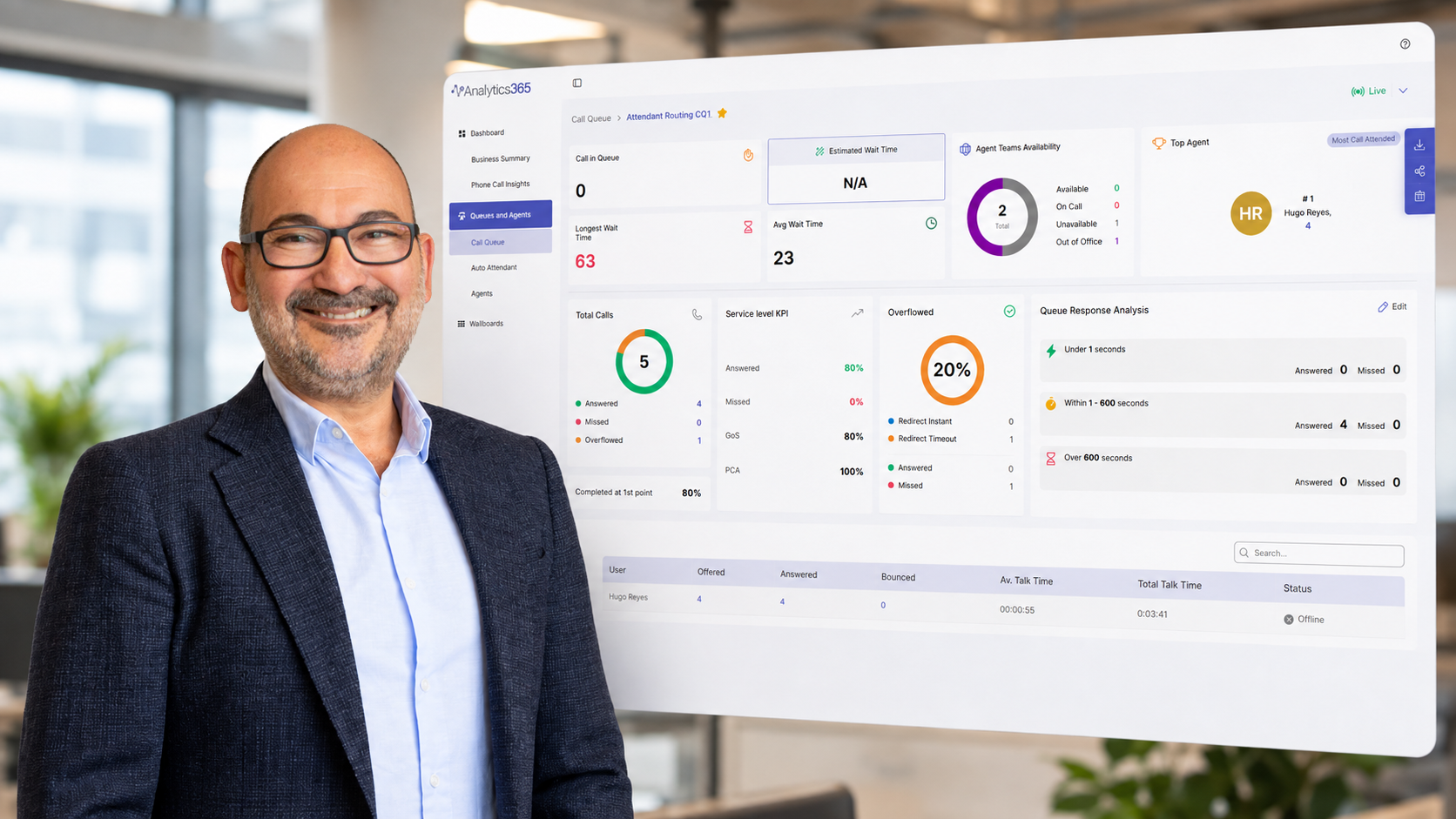
Call Analytics adds that operational layer, giving organisations visibility into customer demand, service levels and team performance. It can highlight missed calls, long wait times and inconsistent performance while providing the historical data needed to identify longer-term trends.
For service providers, this creates value beyond an additional product sale. Analytics can become part of how they support their customers: helping identify problems, responding to changing requirements and demonstrating that their service continues to contribute to the customer's business.
That strengthens the end-user relationship. Instead of the provider becoming less visible once Teams has been deployed, there is an ongoing reason to engage – based on how the customer is actually using the service and what they need to improve next.
And ultimately, that is where the partner opportunity lies: meeting more of the end user's needs, delivering more value around the Teams service, and giving customers stronger reasons to remain with the provider over the long term.




.avif)
.avif)